AI Development Studio

AI Development
Engineered for Production

We build intelligent applications powered by large language models, AI agents, retrieval systems and modern AI architectures. High-performance, deterministic systems designed for scale. As a dedicated AI development team, we handle everything from initial architecture through production deployment and ongoing tuning.

Engineered for Complexity

The problems worth solving with AI are rarely simple — they involve messy legacy systems, unstructured data, and customer interactions that a rigid script can't handle. Here's where we typically start.

Manual Processes

Fragmented workflows and human bottlenecks are transformed into automated, high-velocity pipelines using agentic reasoning. Our engineers map every manual handoff first, then decide which steps genuinely need a model versus deterministic code.

Data Silos

We bridge the gap between unstructured data and actionable intelligence through advanced RAG architectures, connecting document stores, internal wikis, and legacy databases into a single retrievable knowledge layer.

AI Adoption

Overcoming technical debt to integrate modern LLM stacks seamlessly into existing legacy systems, so adopting AI doesn't mean a rewrite — it means a staged rollout with a fallback path at every step.

Sub-par Customer Support

Replace rigid chatbots with empathetic, context-aware AI agents that understand nuanced user intent, escalate appropriately, and improve continuously from real conversation data.

Core Capabilities

We specialize in the frontiers of AI engineering, delivering systems that move beyond simple prompts to autonomous execution.

AI Agents

Our engineering team designs autonomous agents capable of multi-step reasoning, tool use, and task execution — from research assistants to fully automated back-office workflows.

RAG & Semantic Search

We build Retrieval Augmented Generation pipelines that ground large language models in your proprietary data, combining vector search with structured retrieval for pinpoint accuracy at scale.

Document AI

Custom extraction and classification pipelines pull structured data out of contracts, invoices, and unstructured documents using OpenAI, Claude, and Gemini models tuned to your domain.

LLM Integration & Fine-tuning

From prompt engineering and API integration through to fine-tuning open-weight models, we pick the right technique for your accuracy, latency, and cost constraints.

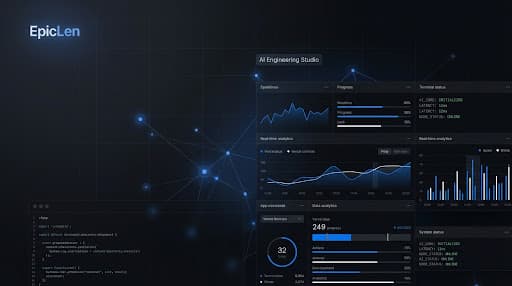
SYSTEM_STATE: OPTIMIZED

LATENCY: 142ms | ACCURACY: 99.8%

tokens8.2k
retrieval96%

pipeline

AI Development Use Cases We Build

Real business scenarios these engagements are built to solve, not just the underlying technology — the specifics of the stack matter far less than whether the outcome actually moves a business metric.

Customer Support Automation

AI agents that triage, respond to, and resolve customer inquiries directly, escalating to a human only when context or stakes genuinely require it — cutting first-response time from hours to seconds without sacrificing the judgment calls that still need a person.

Internal Knowledge Copilots

Retrieval-augmented assistants trained on your internal documentation, past project history, and support tickets, so employees get accurate answers grounded in your actual data instead of a generic model guessing.

Document & Contract Intelligence

Automated extraction, classification, and comparison of contracts, invoices, and compliance documents, turning a task that took a paralegal or analyst hours into a review that takes minutes.

Predictive & Decision-Support Systems

Machine learning models layered on top of your existing data warehouse to forecast demand, flag anomalies, or score leads — decision support that gets smarter as more data flows through it.

Workflow Orchestration Agents

Multi-step agents that chain together API calls, database writes, and business logic to complete entire workflows autonomously, from lead qualification to report generation, with a human checkpoint wherever the stakes require one.

Custom AI Development vs. Off-the-Shelf AI Tools

Off-the-shelf AI tools — a chatbot widget, a generic summarization plugin — get you moving in an afternoon, and for a genuinely generic problem, that's the right call. The trade-off shows up the moment your workflow has a business rule, a data source, or an edge case the vendor didn't anticipate: you're stuck waiting on their roadmap instead of shipping the fix yourself.

Custom AI development earns its higher upfront cost when the system needs to reason over your proprietary data, integrate with internal systems no vendor has pre-built a connector for, or handle a volume and latency profile that off-the-shelf pricing wasn't designed around. The output is also something you actually own — the prompts, the evaluation data, the fine-tuned weights — rather than a black box you rent.

In practice, most of the projects we scope end up as a hybrid: an existing foundation model (OpenAI, Anthropic, or Google) doing the reasoning, wrapped in custom retrieval, business logic, and guardrails that are genuinely yours. That's usually the fastest path to something production-ready that doesn't box you into one vendor.

Our AI Development Process

A five-stage engineering lifecycle that keeps every AI development project accountable to a fixed scope and a measurable outcome, rather than an open-ended experiment with no clear finish line.

01

Discover

We start every engagement by mapping your data sources, existing systems, and the specific decision or workflow you want AI to improve. This scoping phase produces a fixed-cost proposal, not an open-ended retainer.

02

Design

Before writing a line of model-calling code, we architect the system: which parts need an LLM, which need deterministic logic, where retrieval fits, and what happens when the model gets something wrong. Failure modes are designed for, not discovered in production.

03

Build

Our engineers build in short, demoable iterations using Python, FastAPI, and LangChain, with evaluation harnesses running against real data from day one so accuracy is measured continuously, not guessed at the end.

04

Deploy

Every AI system ships behind feature flags with staged rollout, observability dashboards, and rollback paths, so production incidents are caught in hours, not discovered by customers.

05

Scale

Once a system is live, we tune retrieval quality, reduce latency and token cost, and expand coverage into adjacent workflows — the work doesn't stop at launch.

Architected for Longevity

Every project we ship runs on a deliberately small, production-proven stack rather than a different framework for every prototype. That consistency is what lets us move fast without accumulating technical debt.

Languages

Python / TS

Frameworks

FastAPI / LangChain

Vector Infra

Pinecone / Weaviate

Compute

Docker / AWS

Why Choose EpicLen for AI Development

The engineering principles behind every project we ship, from the first prototype through to long-term production ownership.

AI Native

We don't retrofit AI onto existing products. Every engagement starts with a model-agnostic core intelligence layer, so you're never locked into a single vendor's API.

Engineering First

Code quality is non-negotiable. Every AI system we ship includes types, automated tests, and documentation — the same engineering discipline we'd apply to any production software, because an AI feature that can't be maintained isn't actually shipped.

Data as an Asset

Every interaction your AI system handles becomes structured data that compounds in value, feeding evaluation, fine-tuning, and future features instead of disappearing into a chat log.

Security & Privacy by Default

Zero-retention policies, PII filtering, and VPC-isolated inference are the default configuration for every project, not an enterprise upsell.

Built to Scale

Systems are load-tested and architected to survive real production traffic from day one, so a successful pilot doesn't require a rewrite to become a real product.

Technical Deliveries

Selected case studies in intelligent systems — a sample of the work we've shipped into production for clients across financial services, risk, and enterprise search.

Explore all projects
Dark trading dashboard on an ultrawide monitor showing real-time price charts, latency and Sharpe ratio metrics, and a code editor
01

Financial Intelligence

Project Obsidian

A real-time market analysis agent built for a financial services client, combining streaming data ingestion with sub-second retrieval latency so analysts get AI-generated insight alongside live price movement, not minutes behind it.

QuantStream real-time trading analytics dashboard with live market data, order flow visualization, and a signal network graph
02

Quantitative Risk

QuantStream

A high-performance LLM pipeline that parses regulatory filings and compliance documents at scale, extracting structured risk signals that used to take a team of analysts days to compile manually.

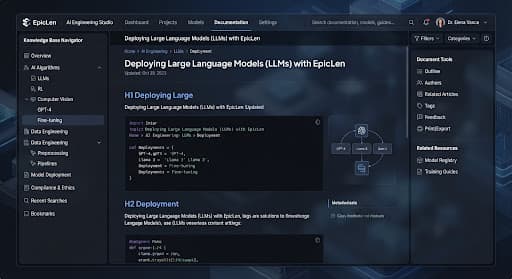
Knowledge base documentation interface showing a large language model deployment guide
03

Enterprise Search

Nexus Systems

A multi-modal knowledge graph connecting documents, spreadsheets, and internal wikis across departments, letting staff query institutional knowledge in natural language instead of hunting through shared drives.

Technical Inquiries

How do you handle data privacy with LLMs?
We prioritize zero-retention policies, PII filtering at the edge, and wherever possible, local inference or VPC-isolated environments for AI integrations.
Can you integrate with existing legacy databases?
Yes. Our engineering team builds custom ETL pipelines and semantic layers that sit atop legacy PostgreSQL, SQL Server, or Oracle instances to make them AI-ready.
What is your typical development lifecycle?
We follow a rigorous 5-stage engineering lifecycle: discover, design, build, deploy, and scale.
How much does AI development cost?
Cost depends on scope: a focused pilot integrating an existing LLM into one workflow is a fraction of a multi-agent platform with custom data pipelines. We typically start with a scoped discovery phase so you get a fixed estimate before committing to a build.
Do you build custom AI models or use existing AI APIs?
Both, depending on the problem. Most AI development projects ship faster and cheaper on top of existing foundation models (OpenAI, Anthropic, Google) combined with RAG or fine-tuning; we only recommend training a model from scratch when there's a clear accuracy, cost, or data-sovereignty reason to.
Which industries do you build AI development projects for?
We've shipped AI development projects for financial services, e-commerce, professional services, and SaaS teams. The industry matters less than whether the workflow has clear inputs, a measurable outcome, and enough historical data to evaluate against.
What happens if the AI system doesn't perform as expected after launch?
Every engagement ships with an evaluation harness and observability dashboard from day one, so underperformance is caught and diagnosed quickly rather than discovered anecdotally — and our staged rollout process means a regression never reaches every user at once.

Ready to Innovate?

Let's build your next-generation AI product with engineering precision and technical excellence. Whether you're exploring your first AI development pilot or scaling an existing system into production, our engineering team is ready to scope the work.

Let's Build Your AI Product